

Understand the starting point
Your first agent includes a flow that can:- Answer business questions using connected knowledge
- Collect the caller’s name, phone number, and reason for calling when follow-up is needed
- End the call after the caller has no more questions
- Send a post-call email notification to the email used during onboarding
You do not need to create another agent just to follow this guide. If you are joining an existing workspace, select the agent you want to configure before continuing.
Learn the parts of an agent
Phonely combines several systems during a call:Voice and Guidelines
Choose the agent’s voice and define the behavior, goals, and limits that apply across calls.
Knowledge
Add focused, up-to-date business information the agent can use to answer customer questions.
Flows
Design preparation, conversation steps, decisions, integrations, transfers, and follow-up actions for each call.
1. Decide what the first call should accomplish
Choose one outcome that matters to your business, such as answering common questions, qualifying a lead, booking an appointment, taking a message, or routing a caller. Write down:- What the caller needs
- What the agent must know or collect
- What a successful ending looks like
- What should happen when the agent cannot complete the request
2. Add accurate business knowledge
Review anything added to the knowledge base during onboarding, then add the documents, written information, or website pages needed for the first call goal. Remove irrelevant or outdated sources so the agent is not expected to choose between conflicting information.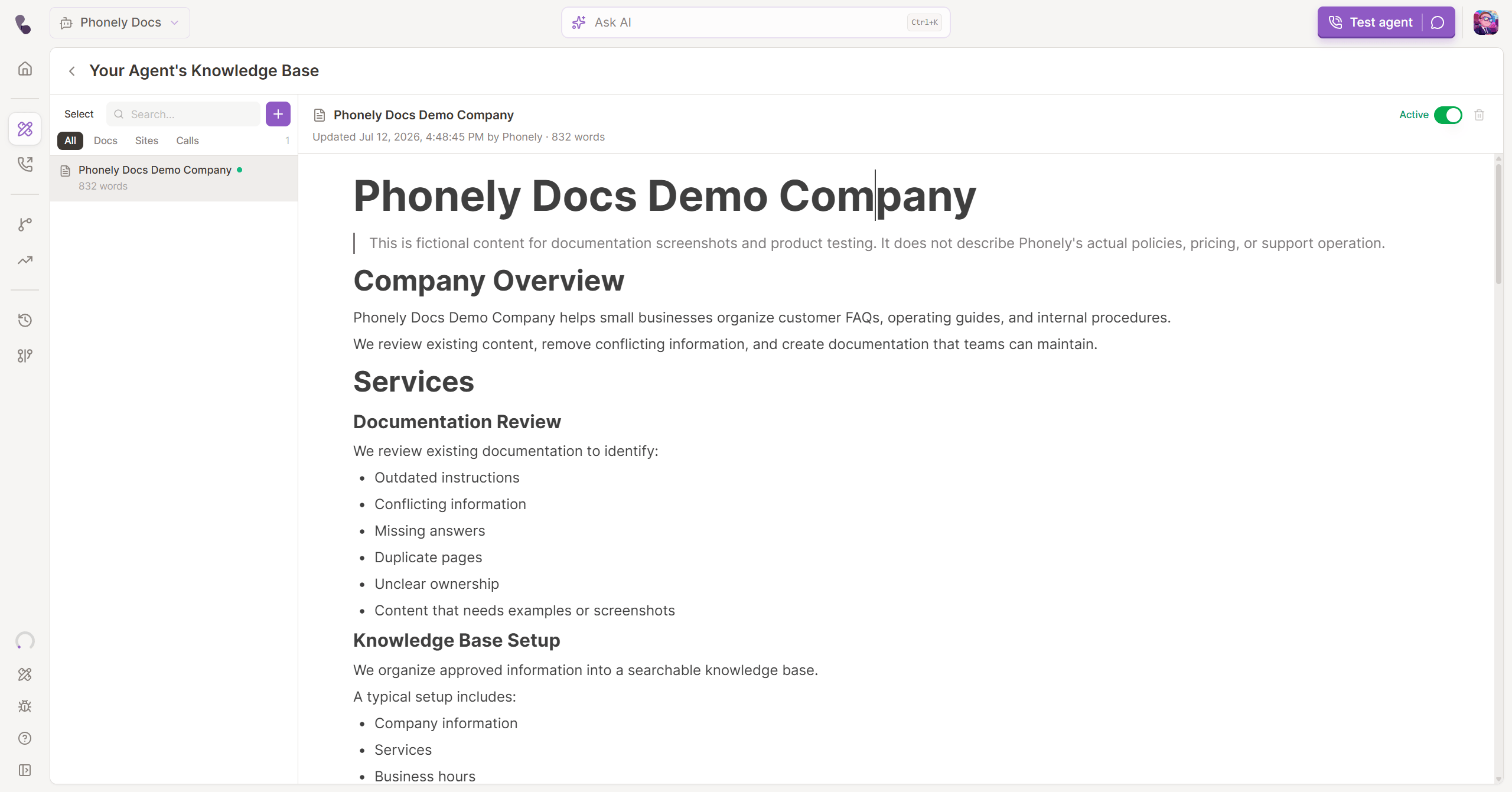
3. Review the agent’s voice and Guidelines
Listen to the agent’s current voice and confirm it fits the callers and situation you expect. Then review the agent’s Guidelines for:- The role the agent should perform
- How it should communicate
- What it must or must not do
- When it should transfer, take a message, or use another fallback
4. Customize the starter flow
Open Call Flows, select the starter flow, and trace it from the incoming-call trigger to each ending. Update the smallest complete path for your first call goal before adding more branches. For each block, confirm:- Its purpose is clear.
- Its instructions use the correct knowledge and variables.
- Every possible result has a useful next step.
- Failure and fallback paths are explicit.
- The call ends or transfers deliberately.
Optional: test part of a complex flow
For a long or complex flow, use Test from here on a block when repeatedly starting from the trigger would slow down iteration. It exercises the current draft from that point without changing the published version handling live calls. Supply representative test values for any variables the block needs, then run the partial path in chat or talk mode. This is a focused debugging tool rather than the main release test. It does not prove that the full flow can be published or that the experience matches a real phone call. See Test and Publish for the full procedure.5. Test the draft
Your edits are saved as a draft while you work. Start Web Call or Web Chat from the Flow Editor to test that draft before publishing it. If the app side panel is already open, select Test Call and choose Talk or Chat. Use Web Chat for a quick functional pass through prompts, variables, routes, and connected actions. Use Web Call when you also need to evaluate voice, tone, pacing, and interruptions.6. Publish and verify the live version
Resolve reachable block errors in the Flow Checklist, then select Publish. Review any advisory findings and publish the draft when it is ready to become the version used by callers. In the Test Call panel, switch from Draft to Live and repeat the important path. Switching targets restarts the test. If a flow has never been published, Phonely falls back to its draft. Ask AI shares the side panel with Test Call but is a separate tool. Begin with the expected successful conversation, then try important variations:- The caller asks a question the knowledge base does not answer.
- Required information is missing or unclear.
- The caller changes direction midway through the call.
- An integration returns no useful result.
- The call needs to transfer or end early.
7. Review and improve
After test or real calls are available, use Call History to compare what happened with the outcome you planned. Check the conversation, path, collected information, and final result. Change the correct layer:- Update the knowledge base when the agent lacked or used incorrect business information.
- Update Guidelines when its general behavior was wrong.
- Update the flow when the sequence, decision, integration, transfer, or ending was wrong.
Continue building
Learn about Flows
Learn how blocks, connections, versions, and call paths work together.
Set Up Your Agent
Review the voice, Guidelines, knowledge, and shared settings that shape the agent.
Review Performance
Use call outcomes and trends to decide what to improve after your first experience is reliable.