> ## Documentation Index
> Fetch the complete documentation index at: https://docs.phonely.ai/llms.txt
> Use this file to discover all available pages before exploring further.
# Variables
> Use fixed and changing values to make a flow respond to each call.
Variables are named values that a flow can use. Some stay fixed, while others change with the caller, the route, or a block's result. They let the flow carry information forward and respond to the current call without entering the same data again.
For example, a Talk block can collect the caller's name, and a later block can use that name in a message or an API request.
## Use a variable
1. Open a block and focus a field that supports variables. The **Available Variables** panel opens with the list already filtered for that block.
2. Select a variable from the list. Phonely adds it to the field.
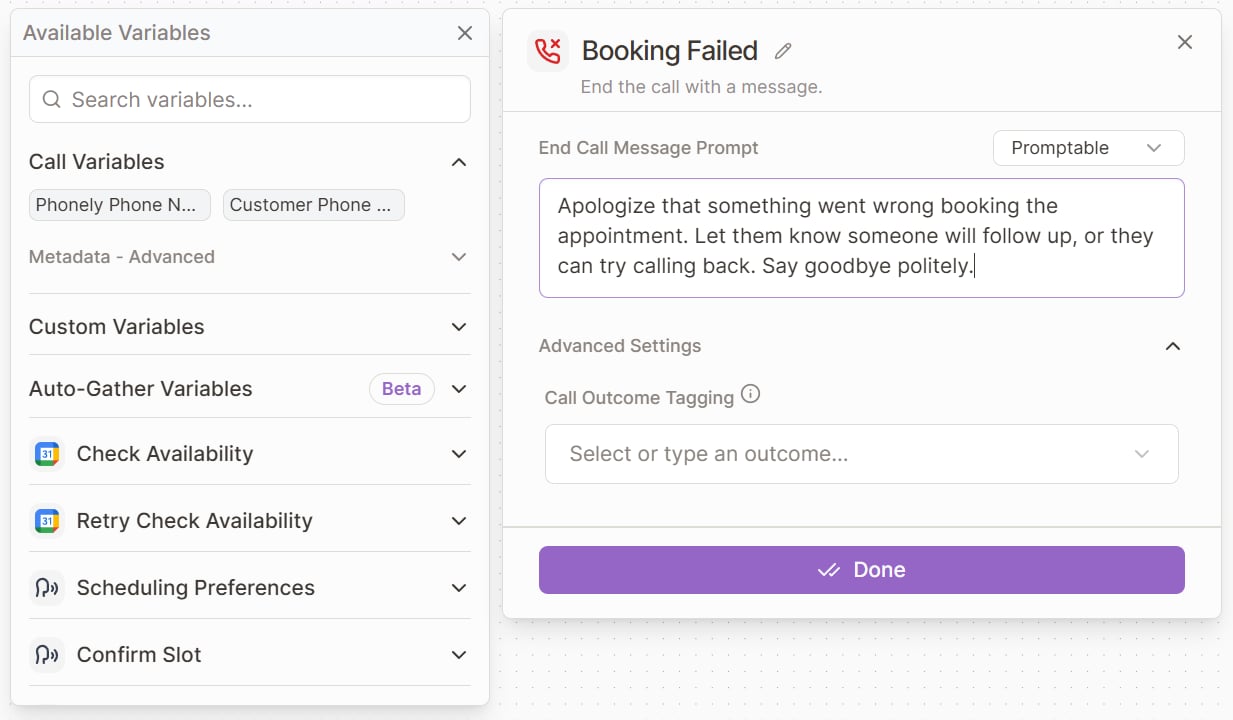 When the block runs, it uses the current value of the variable. Typing the variable's name as normal text does not use its value.
In supported text fields, you can also type `@` and select a variable from the matching results.
If two variables have similar names, check the group they appear under to make sure you select the intended value.
## Where variables come from
The **Available Variables** panel groups variables by their source:
* **A block's variables** appear under its name and contain information that block collected or returned.
* **Call Variables** contain information about the current call, such as phone numbers and call metadata.
* **Custom Variables** contain reusable values you define for the flow.
* **Post Call Variables** contain finalized information such as the transcript, summary, outcome, recording link, and call duration.
* **Outbound Variables** contain values supplied when an outbound call starts.
* **Auto-Gather Variables** provide a shorter way for supported actions to collect information from the caller.
Some fields also show knowledge-base content when you type `@`. Knowledge-base content gives the agent information to reference; it does not store a value that moves through the flow.
## Use variables from blocks
Blocks are the main source of values that change while a flow runs. Their variables are created in three ways:
* **Defined by the configuration:** In Talk and Collect, you name the information the block should collect. Google Sheets uses the selected sheet's columns for its Search a Row variables.
* **Provided by the action:** Some actions have known results. For example, Google Calendar's Check Availability action provides **Available Appointment Slots**.
* **Discovered from test data:** API Request and Code create variables from a successful test result. Webhook creates variables from the fields in a received test payload.
In each case, the variables appear under the block's name and can be selected in blocks that run later.
Tests can also fill variables whose names are already known. A Google Sheets Search a Row test adds the matched row values to its column variables. A Google Calendar availability test fills **Available Appointment Slots**.
### Collect information from the caller
Add a variable to a Talk or Collect block when the block should ask the caller for information. Give the variable a clear name, choose its type, and describe what the agent should collect.
* Enable **Required** when the block must collect the value before it finishes.
* Enable **Confirm** when the caller should verify a required value.
* Enable **Spell Back** when the agent should read a confirmed value character by character.
Confirmation is useful for information where a mistake matters, such as an email address or reference number. Using it for every value can make the conversation repetitive.
### Create variables from test data
For API Request and Code:
1. Configure the block with safe sample data.
2. Run its block-level test.
3. Check the result.
4. Open a later block and select the result you need from **Available Variables**.
For Webhook, start its test and send a sample payload to the displayed webhook URL. Phonely creates variables from the fields it receives.
These variables match the structure of the successful test data. If that structure changes, test the block again and check the later blocks that use its variables.
See [API Request](/blocks/api-request) for request-specific configuration and testing.
## Use Auto-Gather Variables
An **Auto-Gather Variable** is a shortcut for collecting information without adding a separate Talk or Collect block. When a supported action needs the value, the agent asks the caller for it before the action runs.
Use it for a simple value needed mainly by that action. Prefer a Talk or Collect block when collecting the information should be a clear part of the conversation or when several later blocks need the value.
## Use Custom Variables
A **Custom Variable** stores a fixed value with the flow so you can use it in several places. It is useful for repeated configuration such as an API key, account ID, webhook URL, or business constant.
For example, place an API key in a Custom Variable and select it wherever an API Request needs that key. If the key changes, update the Custom Variable instead of editing every request.
Select **+** beside **Custom Variables**, choose **Custom Variable**, then enter its name and value.
Enter API keys and other secrets directly in the **Add Custom Variable** dialog. Do not include secret values in an Ask AI prompt.
### Advanced input sources
The **Add Custom Variable** dialog also supports these specialized inputs:
A Runtime Variable receives its value when a Phonely Web SDK call starts. After creating it, copy the generated Runtime Variable ID and use that ID as the input key in the Web SDK call.
Runtime Variables are currently available only for Phonely Web SDK calls. Their definitions cannot be edited after creation; delete and recreate one if its setup is incorrect.
A SIP Header variable reads a custom header sent with an incoming SIP call. Enter the header name used by the caller's SIP provider. It must begin with `x-`, such as `x-customer-id`.
Phonely reads the matching value from the call metadata. SIP Header definitions cannot be edited after creation; delete and recreate one if its setup is incorrect.
## Use Outbound Variables
In an outbound flow, select **+** beside **Outbound Variables** to add values that will be supplied when a call starts. Create them before using them in later blocks, and give them clear names that are easy to map from the call source.
## When variables are available
The **Available Variables** panel already filters the list for the selected block. These rules explain why a variable may not appear or may have no value:
* A value created by a block can be used only after that block runs.
* If a call takes a different route and skips the block that creates a value, a later shared block may receive no value.
* Outbound Variables appear only in outbound flows.
* Post-call blocks use **Post Call Variables** for finalized call information.
* Transfer Flow keeps the call active, but variables created in the source flow are not available in the target flow.
If a later block needs a value on every route, collect or create it on every route before that block, or make the block handle a missing value.
See [Connections and Routing](/flow-editor/connections-and-routing) when availability depends on how blocks are connected.
## Variable types
Phonely uses two kinds of type information. One guides how the agent collects information; the other records whether a variable's value is text, a number, a boolean, or structured data.
### Types for collected information
When you add a variable to Talk or Collect, or create an Auto-Gather Variable, choose the type of information the agent should collect. The type helps the agent interpret, format, and check the caller's answer.
Use **Text** for an open-ended answer. When the format matters, choose a more specific type such as **Number**, **Age**, **Date**, **Time**, **Name**, **Email**, **Phone**, **URL**, **Address**, **Zipcode**, **Currency**, **Percentage**, or **Duration**.
Use these options when the built-in formats are not enough:
| Type | Use it when |
| :--------- | :--------------------------------------------------------------- |
| **Regex** | The value must match a specific pattern. |
| **Enum** | The value must be one of a defined set of options. |
| **Custom** | The expected format is best explained with a written definition. |
Choose the type that best describes the expected answer. When the format matters, test valid, invalid, and corrected answers.
These collection types describe the meaning and expected format of an answer. They are separate from the data types used for block results.
### Data types for variable values
System-defined variables and values returned by blocks can have a data type of `string`, `number`, `boolean`, `object`, `array`, or `null`. Phonely determines the data type from the variable's definition or a successful block test; you do not select it manually. For example, **Live Call Duration (s)** is a number, **AI Success** is a boolean, and **Topics** is an array. The **Available Variables** panel displays the type beside non-string values.
The data type matters when you pass a value to another system. For example, an API Request or Webhook JSON body can keep `42` as a number, `false` as a boolean, or a complete object or array as structured data instead of converting it to text.
Use an object or array as the complete value of a compatible JSON field, or select one of its nested values. Objects and arrays cannot be mixed into a text sentence, URL, header, or query parameter.
During a block-level test, enter test values that match the type shown for each variable. This lets the test reproduce how the values will be passed when the flow runs.
## Resolve invalid variables
A variable becomes invalid when its value is no longer available to a block. This can happen after you delete the block that created it, change a connection, remove a result field, or delete the variable.
For an isolated reference, open the affected block, remove the invalid variable, and select the intended variable from **Available Variables**. If the intended variable is missing, check the route or recreate the value before selecting a replacement.
When the same invalid reference appears in several fields or blocks, select **Replace Invalid Variables** from the canvas toolbar. The dialog lists the affected blocks and replaces every use of that reference at once. Choose a replacement only when it has the same meaning and is available to every affected block.
## Test and inspect variables
When testing a flow, confirm that:
* the call takes the route that creates the value;
* the agent collects the expected information;
* later blocks receive the correct value; and
* routes that do not create the value still behave safely.
In Web Call or Web Chat, hover over or focus the variable chip below an assistant response to see the values stored during that turn. This is useful for a quick check while testing.
After a completed test or live call, open **Call Details**, select **Blocks**, and expand the relevant block or response. The **Stored Variables** section shows which values were captured at that point in the execution, making this the clearer view when you need to trace a variable to a block.
Web Call and Web Chat do not always provide information that exists only on a real phone call. Complete a phone test when the flow depends on telephony data such as a caller number or transfer timing.
## Troubleshooting
Confirm that the block creating it runs earlier on a route that reaches the selected block. Outbound Variables appear only in outbound flows, and Post Call Variables appear only in post-call blocks.
Check whether those calls passed through the block that creates the value. Create the value on every relevant route, move the block that uses it, or handle the missing value.
Choose a more suitable type and make the description more precise. For strict formats, use Regex, Enum, or Custom, then test valid, invalid, and corrected answers.
Check whether a connection or the block that created it changed. Repair the route when appropriate. Otherwise, remove the invalid reference and select an available variable. Use **Replace Invalid Variables** when the same reference needs to be updated in several blocks.
Browser tests do not always have real telephony information. Provide a test value where supported and verify the final behavior with a phone call.
When the block runs, it uses the current value of the variable. Typing the variable's name as normal text does not use its value.
In supported text fields, you can also type `@` and select a variable from the matching results.
If two variables have similar names, check the group they appear under to make sure you select the intended value.
## Where variables come from
The **Available Variables** panel groups variables by their source:
* **A block's variables** appear under its name and contain information that block collected or returned.
* **Call Variables** contain information about the current call, such as phone numbers and call metadata.
* **Custom Variables** contain reusable values you define for the flow.
* **Post Call Variables** contain finalized information such as the transcript, summary, outcome, recording link, and call duration.
* **Outbound Variables** contain values supplied when an outbound call starts.
* **Auto-Gather Variables** provide a shorter way for supported actions to collect information from the caller.
Some fields also show knowledge-base content when you type `@`. Knowledge-base content gives the agent information to reference; it does not store a value that moves through the flow.
## Use variables from blocks
Blocks are the main source of values that change while a flow runs. Their variables are created in three ways:
* **Defined by the configuration:** In Talk and Collect, you name the information the block should collect. Google Sheets uses the selected sheet's columns for its Search a Row variables.
* **Provided by the action:** Some actions have known results. For example, Google Calendar's Check Availability action provides **Available Appointment Slots**.
* **Discovered from test data:** API Request and Code create variables from a successful test result. Webhook creates variables from the fields in a received test payload.
In each case, the variables appear under the block's name and can be selected in blocks that run later.
Tests can also fill variables whose names are already known. A Google Sheets Search a Row test adds the matched row values to its column variables. A Google Calendar availability test fills **Available Appointment Slots**.
### Collect information from the caller
Add a variable to a Talk or Collect block when the block should ask the caller for information. Give the variable a clear name, choose its type, and describe what the agent should collect.
* Enable **Required** when the block must collect the value before it finishes.
* Enable **Confirm** when the caller should verify a required value.
* Enable **Spell Back** when the agent should read a confirmed value character by character.
Confirmation is useful for information where a mistake matters, such as an email address or reference number. Using it for every value can make the conversation repetitive.
### Create variables from test data
For API Request and Code:
1. Configure the block with safe sample data.
2. Run its block-level test.
3. Check the result.
4. Open a later block and select the result you need from **Available Variables**.
For Webhook, start its test and send a sample payload to the displayed webhook URL. Phonely creates variables from the fields it receives.
These variables match the structure of the successful test data. If that structure changes, test the block again and check the later blocks that use its variables.
See [API Request](/blocks/api-request) for request-specific configuration and testing.
## Use Auto-Gather Variables
An **Auto-Gather Variable** is a shortcut for collecting information without adding a separate Talk or Collect block. When a supported action needs the value, the agent asks the caller for it before the action runs.
Use it for a simple value needed mainly by that action. Prefer a Talk or Collect block when collecting the information should be a clear part of the conversation or when several later blocks need the value.
## Use Custom Variables
A **Custom Variable** stores a fixed value with the flow so you can use it in several places. It is useful for repeated configuration such as an API key, account ID, webhook URL, or business constant.
For example, place an API key in a Custom Variable and select it wherever an API Request needs that key. If the key changes, update the Custom Variable instead of editing every request.
Select **+** beside **Custom Variables**, choose **Custom Variable**, then enter its name and value.
Enter API keys and other secrets directly in the **Add Custom Variable** dialog. Do not include secret values in an Ask AI prompt.
### Advanced input sources
The **Add Custom Variable** dialog also supports these specialized inputs:
A Runtime Variable receives its value when a Phonely Web SDK call starts. After creating it, copy the generated Runtime Variable ID and use that ID as the input key in the Web SDK call.
Runtime Variables are currently available only for Phonely Web SDK calls. Their definitions cannot be edited after creation; delete and recreate one if its setup is incorrect.
A SIP Header variable reads a custom header sent with an incoming SIP call. Enter the header name used by the caller's SIP provider. It must begin with `x-`, such as `x-customer-id`.
Phonely reads the matching value from the call metadata. SIP Header definitions cannot be edited after creation; delete and recreate one if its setup is incorrect.
## Use Outbound Variables
In an outbound flow, select **+** beside **Outbound Variables** to add values that will be supplied when a call starts. Create them before using them in later blocks, and give them clear names that are easy to map from the call source.
## When variables are available
The **Available Variables** panel already filters the list for the selected block. These rules explain why a variable may not appear or may have no value:
* A value created by a block can be used only after that block runs.
* If a call takes a different route and skips the block that creates a value, a later shared block may receive no value.
* Outbound Variables appear only in outbound flows.
* Post-call blocks use **Post Call Variables** for finalized call information.
* Transfer Flow keeps the call active, but variables created in the source flow are not available in the target flow.
If a later block needs a value on every route, collect or create it on every route before that block, or make the block handle a missing value.
See [Connections and Routing](/flow-editor/connections-and-routing) when availability depends on how blocks are connected.
## Variable types
Phonely uses two kinds of type information. One guides how the agent collects information; the other records whether a variable's value is text, a number, a boolean, or structured data.
### Types for collected information
When you add a variable to Talk or Collect, or create an Auto-Gather Variable, choose the type of information the agent should collect. The type helps the agent interpret, format, and check the caller's answer.
Use **Text** for an open-ended answer. When the format matters, choose a more specific type such as **Number**, **Age**, **Date**, **Time**, **Name**, **Email**, **Phone**, **URL**, **Address**, **Zipcode**, **Currency**, **Percentage**, or **Duration**.
Use these options when the built-in formats are not enough:
| Type | Use it when |
| :--------- | :--------------------------------------------------------------- |
| **Regex** | The value must match a specific pattern. |
| **Enum** | The value must be one of a defined set of options. |
| **Custom** | The expected format is best explained with a written definition. |
Choose the type that best describes the expected answer. When the format matters, test valid, invalid, and corrected answers.
These collection types describe the meaning and expected format of an answer. They are separate from the data types used for block results.
### Data types for variable values
System-defined variables and values returned by blocks can have a data type of `string`, `number`, `boolean`, `object`, `array`, or `null`. Phonely determines the data type from the variable's definition or a successful block test; you do not select it manually. For example, **Live Call Duration (s)** is a number, **AI Success** is a boolean, and **Topics** is an array. The **Available Variables** panel displays the type beside non-string values.
The data type matters when you pass a value to another system. For example, an API Request or Webhook JSON body can keep `42` as a number, `false` as a boolean, or a complete object or array as structured data instead of converting it to text.
Use an object or array as the complete value of a compatible JSON field, or select one of its nested values. Objects and arrays cannot be mixed into a text sentence, URL, header, or query parameter.
During a block-level test, enter test values that match the type shown for each variable. This lets the test reproduce how the values will be passed when the flow runs.
## Resolve invalid variables
A variable becomes invalid when its value is no longer available to a block. This can happen after you delete the block that created it, change a connection, remove a result field, or delete the variable.
For an isolated reference, open the affected block, remove the invalid variable, and select the intended variable from **Available Variables**. If the intended variable is missing, check the route or recreate the value before selecting a replacement.
When the same invalid reference appears in several fields or blocks, select **Replace Invalid Variables** from the canvas toolbar. The dialog lists the affected blocks and replaces every use of that reference at once. Choose a replacement only when it has the same meaning and is available to every affected block.
## Test and inspect variables
When testing a flow, confirm that:
* the call takes the route that creates the value;
* the agent collects the expected information;
* later blocks receive the correct value; and
* routes that do not create the value still behave safely.
In Web Call or Web Chat, hover over or focus the variable chip below an assistant response to see the values stored during that turn. This is useful for a quick check while testing.
After a completed test or live call, open **Call Details**, select **Blocks**, and expand the relevant block or response. The **Stored Variables** section shows which values were captured at that point in the execution, making this the clearer view when you need to trace a variable to a block.
Web Call and Web Chat do not always provide information that exists only on a real phone call. Complete a phone test when the flow depends on telephony data such as a caller number or transfer timing.
## Troubleshooting
Confirm that the block creating it runs earlier on a route that reaches the selected block. Outbound Variables appear only in outbound flows, and Post Call Variables appear only in post-call blocks.
Check whether those calls passed through the block that creates the value. Create the value on every relevant route, move the block that uses it, or handle the missing value.
Choose a more suitable type and make the description more precise. For strict formats, use Regex, Enum, or Custom, then test valid, invalid, and corrected answers.
Check whether a connection or the block that created it changed. Repair the route when appropriate. Otherwise, remove the invalid reference and select an available variable. Use **Replace Invalid Variables** when the same reference needs to be updated in several blocks.
Browser tests do not always have real telephony information. Provide a test value where supported and verify the final behavior with a phone call.